

The Baylor Libraries Makerspace Enhances Occupational Therapy with 3D Printing and Scanning Technologies
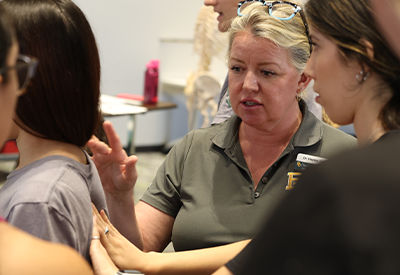
Baylor’s Occupational Therapy doctoral program is updating its curriculum with the help of the Baylor Libraries Makerspace team. In fall 2025, 3D printing was introduced to Occupational Therapy students working on their clinical case studies. With these curricular enhancements, the program has experienced exceptional growth. In 2025, U.S. News and World Report named Baylor's Occupational Therapy program as the top two-year doctoral program. The field has an expected growth of 11%, a $98,000 median salary, and was ranked as a top 10 health care career. With the help of the Makerspace, students in Baylor’s program are gaining an edge on their peers.
“The OTD faculty historically teaches their students how to modify devices when working with their clients, but what they found is that due to advancements in technology and availability is that it wasn’t as cutting edge as a resource anymore,” said Dr. Brett Harper, Manager of Creative Making.
Dr. Teresa Fair-Field, Clinical Assistant Professor, was interested in integrating 3D printing into the curriculum. In fall 2025, OTD faculty partnered with the Makerspace team to develop a lab in which the students would experiment and explore with 3D scanning and printing applied to clinical settings.
“One of the challenges with this particular course was that the OTD program was primarily remote. The students come to campus only a few times a year for a couple of weeks for intensives and labs,” said Dr. Harper.
Because of the difficulty with location and curriculum parameters, the Makerspace team had to come up with a solution that was realistic in a limited time and was compatible with off-campus teaching.
“What we settled on was that we took one of our 3D printers, set it up in a building they were meeting in, and we had a camera on it that was going live that they projected onto a screen so the students could see it printing as they were having their lectures and labs,” Dr. Harper said.
Not only did the OTD faculty see how much these new technologies were building the students’ skills and marketability, but during the interim between classes, Medicaid and Medicare approved reimbursement to clinicians who use specific 3D scanning and printing devices.
When the students arrive on campus for intensives and labs, the Makerspace team already has 3D-printed assistive devices for the course. Professor Fair-Field researched clinical case studies beforehand in which 3D printing was utilized and brought that forward to integrate into the OTD curriculum.
“The students would read up on the case studies to understand the different clients' needs; they then would brainstorm how 3D printing could be utilized to help those particular patients, discussing how the custom devices would work for the patients,” Dr. Harper said.
The course was so well-received that multiple students asked to have their capstone project on 3D printing technologies. Shortly after Dr. Fair-Field's class, the Makerspace team was contacted by Dr. Ricardo Altahif, Clinical Assistant Professor, who is interested in custom orthotics and prosthetics for those with traumatic injuries or in rehabilitation. Dr. Altahif wanted to explore the possibility of expanding on the 3D printing project by integrating 3D scanning into the pipeline with the goal of creating custom splints. Fortuitously, the Makerspace had recently acquired an Artec Spider ll ultra high resolution 3D scanner that they used to create a 3D model of Dr. Altahif’s forearm
“We printed Dr. Altahif’s forearm and hand, and he then presented this to the students so they could use those 3D prints to create custom splints that would fit specifically to his hand. The hope was to have a custom device that could have better clinical outcomes,” Dr. Harper said.
Leveraging 3D scanning and printing technologies holds promise for enhanced treatments for wound care, more individualized physical pathology, and better customization to patients. The Occupational Therapy program is far from the only department to utilize the Makerspace to expand knowledge through creative technologies. In the fall 2025 semester alone, more than 60 classes from 23 different departments within Baylor also use the Makerspace area to enhance their curriculum. These may be early days for the melding of technology and course curriculum, but it most certainly will not be the last.