

Cox Reception Hall
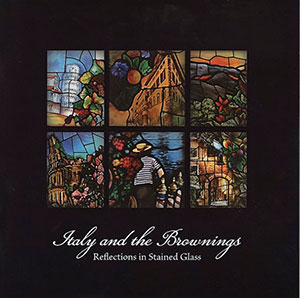
Robert and Elizabeth Barrett Browning moved to Italy shortly after their marriage in 1846 and eventually settled in the city of Florence. This was to be their permanent home until Elizabeth's death in 1861. Although they called Florence home for fifteen years, they traveled throughout Italy, staying in cities such as Venice and Rome for extended periods. As a result, Italy had a profound influence on the lives and the poetry of both poets.
The Cox Reception Hall was created during a 1994/1995 renovation of the ABL's first floor, funded by a gift from Margaret Cox of Houston. During the tenure of Dr. Mairi Rennie as Director of the ABL (1996 - 2002), a plan was formulated to convert the six large window spaces into stained glass. Research was conducted to select memorable quotations from the poetry of the Brownings; and, as a result, six themes were selected for the windows.
As donors began to come forward, Willet Hauser Architectural Glass of Philadelphia was chosen to design and create the windows. Willet designer Jane Collins and glass painter Magdi Mushriqui were instrumental in the inspirational qualities of each of the windows, with installation taking place between April 2001 and November 2007. The Cox Reception Hall windows add significant beauty to the Library and underscore the ABL's claim of holding the largest collection of secular stained glass in the world.
The basic design for each window incorporates a large wreath that surrounds a central image of an Italian location significant in the lives of the Brownings, along with memorable quotations gleaned from their poetry. Vignettes in the corners of the windows represent various aspects of the central subject. In addition, each of the six windows includes a dedication panel, located in a lower corner.
Please take a moment to enjoy the beauty of these windows, by choosing from the links below.
Cox Reception Hall
Willet Hauser Architectural Glass, Philadelphia, Pennsylvania, 2001
In memory of
Lois Smith Douglas Strain
English Professor and Author
by her friends and former students
Hill to hill and turret to turret
Flashing the tricolor,--newly created
Beautiful Italy, calm unhurried,
Rise heroic and renovated,
Rise to the final restitution.
"Italy and the World" E.B.B.
Open my heart and you will see
Graved inside of it, 'Italy.'
Such lovers old are I and she:
So it always was, so shall ever be!
"De Gustibus--" R.B.
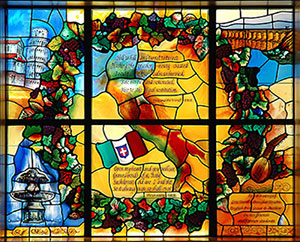
The grapevine, closely associated with both the beautiful Italian landscape and Italian culture, forms the Italy Window's wreath, with ripe clusters of grapes in purple, red, and blue tones and varied-colored leaves in green and a touch of autumn's orange.
The central image shows the Italian peninsula, representing Italy as a whole. The tri-color flag, mentioned in the EBB quotation, was in use at the time of the Brownings' residence (1846-1861) and commemorates the hope of Italian nationhood which the Brownings, particularly Elizabeth, passionately shared.
The famous Leaning Tower of Pisa, the bell tower of the cathedral, is pictured in the upper left corner of the window. Upon arrival in Italy following their marriage in London on September 12, 1846, the Brownings lived in Pisa for five months before moving to the city of Florence.
Enhancing the window's lower left corner is an effervescent fountain representing one of the twin seventeenth-century fountains in Rome's St. Peter's Square. It is reminiscent of Italy's many fountains.
A Roman aqueduct, reflecting the sense of history that is inescapable when one travels throughout Italy, is depicted in the window's upper right corner.
In the lower right, an ancient lute evokes the music of Italy and recalls Robert Browning's love of music. In his poem "Parleyings with Charles Avison" he wrote, "There is no truer truth obtainable by man than comes of music."
Cox Reception Hall
Willet Hauser Architectural Glass, Philadelphia, Pennsylvania, 2001
In memory of
George and Violet Jones
and Paul and Johnnie Powell
by Sid and Jane Jones
River and bridge and street and square
Lay mine, as much at my beck and call,
Through the live translucent bath of air,
As the sights in a magic crystal ball.
"Old Pictures in Florence" R.B.
The city lies along the ample vale,
Cathedral tower and palace, piazza and street,
The river trailing like a silver cord
Through all.
Aurora Leigh E.B.B.
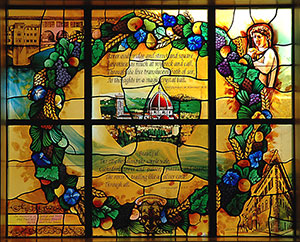
The amber-colored Florence Window displays a central scene of the cathedral or Duomo, officially Santa Maria del Fiore, and the bell tower or Campanile, presented in a circular shape to suggest the "magic crystal ball" in the quotation by Browning. The Arno River flows under the Ponte Vecchio on the upper left and trails through the window's center "like a silver cord," using Elizabeth's words.
This wreath is inspired by the designs of the Florentine Della Robbia family of Renaissance sculptors known for crafting charming, lifelike garlands and wreaths of fruit and flowers in colored, glazed terracotta. It is made up of wheat tassels, blue flowers, varied leaves, and an abundance of fruit--pears, grapes, lemons, and peaches. At the base of the wreath, in red as it is most often seen, is the Florentine Fleur-de-lis, a popular emblem of the city.
The Ponte Vecchio, literally translated Old Bridge and the oldest of Florence's bridges, is seen in the upper left corner, arching over the Arno River. Casa Guidi, the Brownings' home in the city, was within walking distance. In medieval times, the bridge was home to food shops and butchers, but in the nineteenth century, as now, the merchants in the many small shops clustered on the bridge were mainly jewelers.
Michelangelo's David, a masterpiece of Renaissance sculpture, looks down from the upper right, representing a legacy of world-renowned works by Florentine artists.
In July 1847 the poets moved to an apartment of seven rooms in the Palazzo Guidi on the Via Maggio, very near the Pitti Palace and the Boboli Gardens. They referred to the apartment as "Casa Guidi," and it became their principal residence until Elizabeth's death in 1861.
Cox Reception Hall
Willet Hauser Architectural Glass, Philadelphia, Pennsylvania, 2007
In honor of our loving parents,
Bob and Anna Wright,
by their children
Cheryl Wright Henry,
Kelly Wright and Gail Wright
See the crush'd column, and the ruin'd dome--
'Tis all Eternity has left of Rome!
An Essay on Mind E.B.B.
What is left for us, save, in growth
Of soul, to rise up...from the finite to infinity,
And from man's dust to God's divinity?
"Christmas-Eve" R.B.
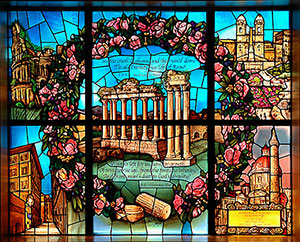
The joyful wreath of the Rome Window is made up of pink roses, laurel and olive leaves, purple berries of the laurel tree, and pale gold and white buds of the olive tree flower. At the bottom of the wreath is a portion of a fallen column, an image taken from an illustration by George Vivian in Views from the Gardens of Rome and Albano (1848).
Ruins in the Roman Forum, overgrown with vines, form the central image of the window. The specific ruins are those of the Temples of Saturn and Vespasian, based on a nineteenth-century photograph taken by Robert Macpherson. The bright blue sky denotes a beautiful, clear day in May.
Seen in the upper left of the Rome Window is a portion of the magnificent Roman Colosseum (the Flavian Amphitheatre), mentioned by both poets in their letters. In later life, Browning enjoyed telling the story of being in a part of men who, after meeting at a restaurant, set off in two carriages to view the Colosseum by moonlight.
In the window's lower left is a view, from an early photograph, of the Via Bocca di Leone. A baroque composition in stucco of a Madonna, under a canopy of drapery supported by an angel, is on the corner of the building where the Brownings lived while in Rome. Beneath that is a blue plaque commemorating their stay.
A view of the long, sweeping staircase known as the Spanish Steps is the focus of the vignette in the upper right corner. Pink azaleas adorn the way to the lovely French church, the Trinita deil Monti, at the op. The Piazza di Spagna at the base of the steps is very near the street where the Brownings resided in Rome.
In the lower right is an image of Trajan's Column (A.D. 113), raised in honor of the Roman emperor Trajan. The stunning stone-carved reliefs winding around the hundred-foot column portray victorious military campaigns and are a significant creation of Roman art.
The overall design of the Rome window was largely inspired by the following quotation from On Two Continents: Memories of a Half a Century by Marie Hansen Taylor (1905): "This was May, He who has never spent that exquisite month in Rome knows not how beautiful she is. The gray masonry of the ruins, on which the nimble lizards have hitherto sunned themselves, are covered as if by enchantment with green blossoming vines, the villas are gardens of roses in which nightingales sing, luxuriant vegetation is everywhere...."
Cox Reception Hall
Willet Hauser Architectural Glass, Philadelphia, Pennsylvania, 2007
In memory of Ann Vardaman Miller
by her friends and former students
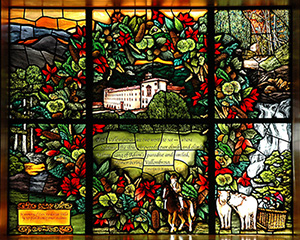
And Vallombrosa, we two went to see--where
Sublime the slow pinewoods ever climb and climb.
Milton sang of Adam's paradise and smiled,
Remembering Vallombrosa.
Casa Guidi Windows E.B.B.
The wreath in the Vallombrosa Window reflects the brilliant foliage of this mountainous region, emphasizing the abundant chestnut forests with chestnut leaves and flowers (long, creamy-colored catkins), the light green "spikey balls" that burst open to reveal the fruit inside, and the resulting brown chestnuts. Also in the wreath are fir tree branches and fir cones, the leaves of the beech tree, and red Virginia creeper, a vine that grows on the monastery walls.
The central image shows the Vallombrosa monastery from much the same angle as a rough sketch drawn by EBB shortly after the Brownings' visit in July 1847. In the hills overlooking the monastery is seen Il Paradisimo (the small paradise), built originally as a hermitage or place of secluded retreat. The time of year represented is June or July, and a mixture of olive and forest greens establishes the overall color scheme of the window.
The sun rises in the upper left over a dramatic prospect--"a great sea of Appenines...all wild and purple," as Elizabeth described the mountainous view from Vallombrosa. The Brownings' journeys both up and down the mountain began in early morning and her letters describing the experience are full of descriptive exclamation: "Never shall I forget the glory of that morning's spectacle...."
In the lower left corner are boulders and beech trees with their talk, straight gray trunks, standing near a little "streamlet" that forms a pool reflecting the glow of the sunrise.
The forest scene in the upper right corner, with the beginning of a waterfall cascading downward, recalls the scenery the Brownings' encountered on their way to Vallombrosa. EBB was thrilled by the experience: "Such scenery...--such rocks & torrents, such chasms & ravines!... It was a sight to see before one died & went away to another world."
In the vignette in the lower right is an image of Elizabeth and her maid Wilson, with a colorful parasol and hat defining the figures, being drawn up the mountain in a basket sledge pulled by two white oxen. Browning rides alongside on horseback in the central portion of the window.
Cox Reception Hall
Willet Hauser Architectural Glass, Philadelphia, Pennsylvania, 2004
Given by Ethel and Rex Ramsower
In memory of her mother and grandmother
Laura Higginbotham Osborne
Ethel Lattimore Higginbotham
"They inspired me to love Browning"
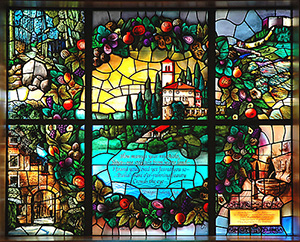
How many a year, my Asolo,
Since--one step just from sea to land--
I found you, loved yet feared you so--
...Italia's rare o'er-running beauty
Crowds the eye--
"Prologue" Asolando R.B.
The abundant richness of the wreath in the Asolo Window evokes the feel of an autumn harvest and is a visual feast, with figs (whole and cut) and fig leaves, grapes, walnuts, pomegranates in varying stages of ripeness, the blue berries of Virginia creeper, and other foliage.
The central image is the view from the loggia at LaMura, the summer home of Browning's close friend Katharine de Kay Bronson. During his last visit to Asolo, the poet insisted on never missing the sunsets from the sheltered balcony, and he envisioned building a tower just across the steep ravine. Pippa's Tower, pictured here, was built instead by his son, to honor his father's memory. The window is set in late summer or early fall, the time of Browning's arrival in Asolo for his final visit in 1889.
The rural road or walking path in the vignette in the upper left corner represents the many carriage rides and lengthy walks Browning enjoyed during his visits to Asolo. The poet had a deep appreciation for the unusual beauty of the area calling it "the most beautiful spot I ever was privileged to see."
In the lower left is pictured Asolo's south gate, the Porta Loreggia. A glimpse of the home of Katharine de Kay Bronson, where Browning spent many happy hours, is seen on the left. It was called La Mura, meaning "the wall," because it was set into the old wall of the city.
In the upper right corner is an image of La Rocca ("the fortress"), the ruins of a pre-Roman stronghold that crowns the hill above the town, with vineyards spilling down the base of the slope. Browning enjoyed taking the steep climb to the summit, where the view on a clear day included Venice's Campanile and the domes of Padua.
The Fontanina Zen or Zen Fountain, dating from 1571, is shown in the lower right corner of the window. It is located just outside La Mura. On his final visit to Asolo, Browning lodged nearby on the street now called Via Roberto Browning.
Cox Reception Hall
Willet Hauser Architectural Glass, Philadelphia, Pennsylvania, 2002
In grateful memory of
Dr. Luther Weeks Courtney
by Jesmarie Harvey Hurst
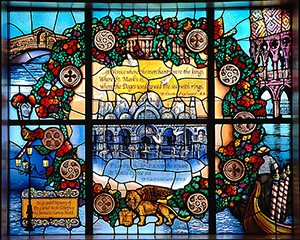
...at Venice where the merchants were the kings,
Where St. Mark's is, where the Doges used to
wed the sea with rings.
"A Toccata of Galuppi's" R.B.
Following the doves across the square
At Venice by the sea.
"A Tale of Villafranca" E.B.B.
Red geraniums, ivy, and other flowers overflow from the balcony at the top of the Venice Window, suggesting the many window boxes brightening the buildings along the Grand Canal. The stone-colored medallions interspersed among the wreath's flowers, representing the architectural riches of the city, were inspired by illustrations from a book by John Ruskin called The Stones of Venice (1851-53). Ruskin, a friend of the Brownings and a major art critic of the nineteenth century, is well-represented in the ABL collections. The winged Lion of Venice is depicted at the bottom of the wreath.
In the central image of the window is St. Mark's Basilica, viewed from St. Mark's Square in the heart of Venice. White doves fly overhead, as mentioned in the EBB quotation. Because of the city's close proximity to the sea, blue is the predominate color in the window, but shades of pink, coral, red, orange, and green, suggesting colorful Venetian glass, are also reflected in this vibrant work of art.
The Rialto Bridge or Ponte di Rialto, the oldest bridge spanning the Grand Canal, defines the upper left vignette. The present stone bridge, a single span, was completed in 1591 and replaced earlier wooden bridges. The bridge features an arched center portico with inclined ramps on either side and numerous small shops.
Seen in the window's lower left corner is one of the traditional and impressive street lights illuminating the Grand Canal, and above are brightly decorated Carnivale masks, thus linking two elements of mysterious nighttime in Venice.
A glimpse of the Doge's Palace or Palazzo Ducale from the Grand Canal is seen in the upper right corner. The home of the Doge, the elected ruler of the city, was the seat of the government of Venice for centuries and is a superb example of Venetial Gothic architecture. The Doge performed a yearly ceremony of wedding Venice to the sea by tossing a gold ring into the waves, as mentioned in the RB quotation.
The prow of a gondola, a traditionally dressed gondolier in the distance, and several colorful mooring poles grace the shimmering water in the lower right corner.
Information for these pages is drawn heavily from a 2008 publication by Cynthia A. Burgess, Curator of Books and Printed Materials at the Armstrong Browning Library. Her booklet, Italy and the Brownings: Reflections in Stained Glass gives additional insights into the inception of the window project, the generous donors, and the creation and installation process. Copies of the booklet are for sale in the ABL Gift Gallery.