

Martin Entrance Foyer
Three of Robert Browning's best short poems are represented in the Martin Entrance Foyer. Using the links below, please take a moment to enjoy the beauty of these windows and to study their accompanying poetry.
Martin Entrance Foyer (left window)
Charles J. Connick Associates, Inc., Boston, Massachusetts
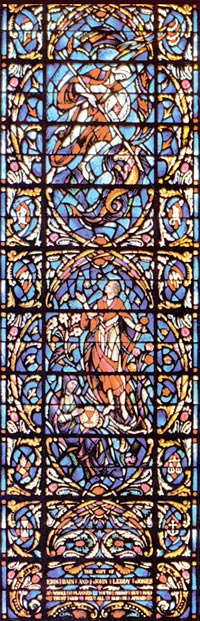
The theme of Robert Browning's "Rabbi Ben Ezra," symbolized in this double window, is well expressed in three sections - reflecting power, strife, and love.
The upper window symbolizes God as the "Potter," as described in Browning's poem, who is holding the Cup ("Perfect the cup as planned!"). At either side are the figures of Age and the Potter's wheel.
The lower medallion is shared by aspiring Youth ("Youth shows but half") and the seated figure of Age ("Grow old along with me! The best is yet to be.") He contemplates the Cup of Life. Lilies and roses surround these figures. Dominating the central medallion, above these two figures, is a knight in armor battling a monster amid storm and strife. This scene brings to mind another line from this powerful poem,
"Then, welcome each rebuff . . . ."
Excerpts from Robert Browning's "Rabbi Ben Ezra"
Poetry for Upper Section of Window
Look not thou down but up!
To uses of a cup,
The festal board, lamp's flash
and trumpet's peal,
The new wine's foaming flow,
The Master's lips aglow!
Thou, heaven's consummate cup, what needst
thou with earth's wheel?
So, take and use thy work:
Amend what flaws may lurk,
What strain o' the stuff, what warpings past the aim!
My times be in thy hand!
Perfect the cup as planned!
Let age approve of youth, and death
complete the same!
Poetry for Lower Section of Window
Grow old along with me!
The best is yet to be,
The last of life, for which the first was made:
Our times are in his hand
Who saith, "A whole I planned,
Youth shows but half; trust God:
see all, nor be afraid!"
"Which rose make ours,
Which lily leave and then as best recall?"
Not that, admiring stars,
It yearned, "Nor Jove, Nor Mars;
Mine be some figured flame which
blends, transcends them all!"
Then, welcome each rebuff
That turns earth's smoothness rough,
Each sting that bids nor sit nor stand but go!
Be our joys three-parts pain!
Strive, and hold cheap the strain;
Learn, nor account the pang; dare, never
grudge the throe!
A whole I planned, Youth shows but half;
trust God: see all, nor be afraid!
The Gift of Erin Bain and
John Leddy-Jones
Martin Entrance Foyer (central window)
Charles J. Connick Associates, Inc., Boston, Massachusetts
The central double window in the Martin Entrance Foyer represents Robert Browning's poem "Abt Vogler," which he subtitled "(After He Has Been Extemporizing Upon the Musical Instrument of His Invention)." It is about an actual eighteenth-century organist who was famous for extemporizing. Abt Vogler created his music at the spur of the moment as he sat at his instrument and played.
The poem is a soliloquy, with Abt Vogler talking to himself as he has finished playing. He describes the music just created as a structure--like a beautiful palace--that he builds around himself. He knows that once he takes his fingers from the keyboard his palace of sound will vanish; and he wishes that, like a true palace, it could last forever.
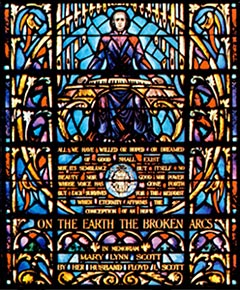
The lower portion of the window illustrates this scene beautifully. Above Vogler's crest is seen the musician seated at the instrument of his own invention, building the palace of sound around himself as he plays. The circle or arc surrounding him is broken in several places. This suggests that nothing is complete, perfect, or lasting in mortal life ("On the earth the broken arcs"). Vogler's consolation as he mourns his lost music is his belief that, "All we have willed or hoped or dreamed of good shall exist . . . when eternity affirms the conception of an hour." In other words, all good things will be made eternal by God.
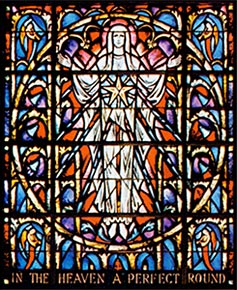
In the upper portion of the window is the symbol of the Palace of Sound ("rampired walls of gold as transparent as glass") and the "perfect round"--symbolizing the perfection and permanence to be found in heaven. Within the circle stands the figure of creative music in silvery white. The radiating gold star on a field of blue is the symbol of harmony ("That out of three sounds he frame, not a fourth sound, but a star"). Musical angels adorn the corners in both segments of the window.
Excerpts from Robert Browning's "Abt Vogler"
Poetry for Upper Section of Window
But here is the finger of God,
a flash of the will that can,
Existent behind all laws,
that made them and, lo, they are!
And I know not if, save in this,
such gift be allowed to man,
That out of three sounds he frame,
not a fourth sound, but a star.
In the heaven a perfect round
Poetry for Lower Section of Window
All we have willed or hoped
or dreamed of good shall exist;
Not its semblance, but itself;
no beauty, nor good, nor power
Whose voice has gone forth,
but each survives for the melodist
When eternity affirms the conception of an hour.
On the earth the broken arcs
In Memoriam Mary Lynn Scott
by her husband Floyd L. Scott
Martin Entrance Foyer (right window)
Charles J. Connick Associates, Inc., Boston, Massachusetts
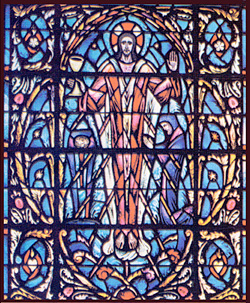
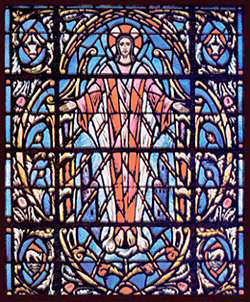
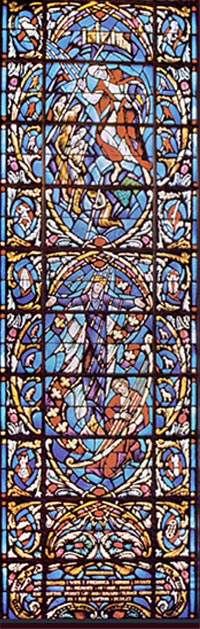
This double window devoted to Robert Browning's poem "Saul" beautifully balances the composition of the Rabbi Ben Ezra Window. The other window's medallions of Youth and Age, a knight battling a monster, and God the "Potter," are echoed in the Saul Window's depictions of David before Saul, Saul battling the Philistines, and Christ the Redeemer. Browning's poem builds to David's prophetic vision of God's plan for the redemption of mankind through Christ.
In the upper window, the radiant figure of Christ as the Redeemer stands before the Gates of Heaven, "See the Christ stand."
In the lower window, David kneels and plays the tune "for which quails on the cornland will each leave his mate." Looking down on David is the dark figure of Saul, "erect as that tent-prop, both arms stretched out wide" with flashes of light across his body from "a sunbeam, that burst thro' the tent roof." Nearby are the quail, the sheep, and the jerboa mentioned in the poem. The center medallion shows Saul in "manhood's prime vigor," as he goes forth to battle. Rays of light from the Hand of God fall toward Saul signifying heavenly approval of his early deeds. Above is the symbol of a city, "a people is thine."
Excerpts from Robert Browning's "Saul"
Poetry for Upper Section of Window
O Saul, it shall be
A Face like my face that receives thee:
a Man like to me,
Thou shalt love and be loved by, forever:
a Hand like this hand
Shall throw open the gates of new life to thee!
See the Christ stand!
Poetry for Lower Section of Window
Then a sunbeam, that burst through the tent-roof,
showed Saul.
He stood as erect as that tent-prop, both arms
stretched out wide . . . .
-Then the tune for which quails on the cornland
will each leave his mate
To fly after the player; then, what makes the
crickets elate
Till for boldness they fight one another; and
then, what has weight
To set the quick jerboa a-musing outside his
sand house-
There are none such as he for a wonder, half
bird and half mouse!
God made all the creatures and gave them our
love and our fear,
To give sign, we and they are his children, one
family here.
He is Saul, ye remember in glory,--ere
error had bent
The broad brow from the daily communion;
and still, though much spent
Be the life and the bearing that front you, the
same, God did choose,
To receive what a man may waste, desecrate,
never quite lose.
Honoring My Beloved Wife
Fredrica Gross Dudley and
In Memory of Our Sons
Ray Lofton Dudley, Jr., and
Bayard Turner Gross Dudley
Gift of Ray Lofton Dudley
These three double stained-glass windows dominate the outside wall of the Martin Entrance Foyer and were created by Charles J. Connick Associates Inc. in Boston, Massachusetts. In a letter dated 5 March 1946, Orin E. Skinner, Secretary to Mr. Connick, shared the plan for the development of the three windows:
"The conception involves great medallions outlined and defined by growing decorative vine forms interlacing and enclosing a multitude of significant symbolism related to each central theme. Blue may be said to be the dominant color note, as in most distinguished windows, although it is well foiled with fine pure ruby, lovely passages of green and violet, and threads of gold and silver woven throughout the pattern, like the sturdy supporting structure of black, playing an important part in harmonizing and accenting the value of pure color.
"Bells and pomegranates are suggested in significant positions. The foliated vine is fruitful with ruby pomegranates and the blue bells are especially in evidence in the dark red field around Abt Vogler, 'an alternation of poetry and thought.'
"While conceived in full color, the design is carefully planned to admit an abundance of illumination of the foyer, and to glorify that interior in sparkling color and light."