

Belew Scholars' Room
The Belew Scholars' Room, originally the classroom of Dr. A. J. Armstrong, holds six stained glass windows that were created by Charles J. Connick Associates, Inc., Boston, Massachusetts. These windows were enjoyed by students as they attended English classes in the room from 1951 until 1982, the year the English Department relocated to Carroll Science Building. A renovation of the classroom in 1995, made possible by donations from Dr. and Mrs. John S. Belew, Katherine Belew Gorham, and others, turned the room into a tranquil and secure setting for scholarly research. Today, researchers, students, and visitors are inspired by the windows.
By using the links below or in the callout box at the bottom right, please take a moment to view images of the six windows and the accompanying quotations from the Brownings' poetry.
Belew Scholars' Room
Charles J. Connick Associates, Inc., Boston, Massachusetts
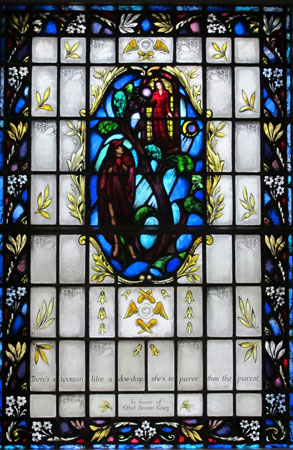
Browning's play A Blot in the 'Scutcheon: A Tragedy was written in 1843 at the request of William Macready, and very rapidly, in four or five days. A misunderstanding led to a breach between the two friends. Although the three-act play was received with enthusiasm, circumstances prevented it from having a long run. The central image suggests the setting of the Earl's song. He is represented in hat and cloak beneath the tree, with Mildred silhouetted against her latticed window casement. The first phrase of his song is the quotation in the window.
Excerpt from Robert Browning's
A Blot in the 'Scutcheon: A Tragedy
There's a woman like a dew-drop, she's so purer
than the purest:
And her noble heart's the noblest, yes, and her
sure faith's the surest:
And her eyes are dark and humid, like the depth
on depth of lustre
Hid i' the harebell, while her tresses, sunnier than
the wild-grape cluster,
Gush in golden-tinted plenty down her neck's rose
misted marble:
Then her voice's music . . . call it the well's
bubbling, the bird's warble!
There's a woman like a dew-drop,
She's so purer than the purest.
In honor of Ethel Brown Casey
Gift of Carl Casey, Jr.
Belew Scholars' Room
Charles J. Connick Associates, Inc., Boston, Massachusetts
ÂÂ
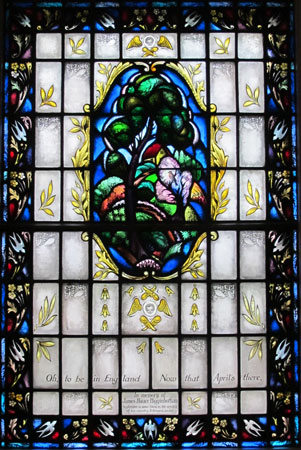
True to the nostalgia of "Home-Thoughts from Abroad," the main image of the window suggests a rural English countryside, with lanes and hedgerows. The dominant elm tree in "tiny leaf" is surrounded by the "brush-wood sheaf," while the chaffinch sings in the blossoming pear tree. The border design is composed of buttercups and swallows.
Robert Browning's
"Home-Thoughts from Abroad"
Oh, to be in England
Now that April's there,
And whoever wakes in England
Sees, some morning, unaware,
That the lowest boughs and the brush-wood sheaf
Round the elm-tree bole are in tiny leaf,
While the chaffinch sings on the orchard bough
In England--now!
And after April, when May follows,
And the whitethroat builds, and all the swallows!
Hark, where my blossomed pear-tree in the hedge
Leans to the field and scatters on the clover
Blossoms and dewdrops--at the bent spray's edge--
That's the wise thrush; he sings each song twice over,
Lest you should think he never could recapture
The first fine careless rapture!
And though the fields look rough with hoary dew,
All will be gay when noontide wakes anew
The buttercups, the little children's dower
--Far brighter than this gaudy melon-flower!
Oh, to be in England now that April's there.
In memory of James Horace Higginbotham
Gift of Mr. & Mrs. A. Baker Duncan
Belew Scholars' Room
Charles J. Connick Associates, Boston, Massachusetts
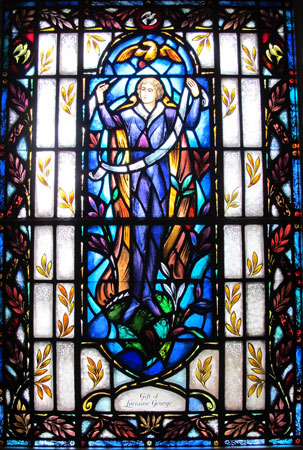
The idealistic figure of the young poet Shelley dominates this window. He is depicted holding a moulted eagle feather above his head, with a wing-spread eagle above. Copper beech and nightingales enrich the border, motifs that are also used in the Sordello Window, a companion window in the Belew Scholars' Room.
This four-stanza poem recounts a meeting between the narrator and another man who had once met Shelley. Based on an actual occurrence, Robert Browning remarked to W. G. Kingsland: "I still vividly remember how strangely the presence of a man who had seen and spoken with Shelley affected me." The narrator in the poem is excited about hearing the story and reflects on how small moments can stay with us forever.
Robert Browning's
"Memorabilia"
Ah, did you once see Shelley plain,
And did he stop and speak to you,
And did you speak to him again?
How strange it seems and new!
But you were living before that,
And also you are living after;
And the memory I started at--
My starting moves your laughter!
I crossed a moor, with a name of its own
And a certain use in the world no doubt,
Yet a hand's-breadth of it shines alone
'Mid the blank miles round about:
For there I picked up on the heather,
And there I put inside my breast
A moulted feather, an eagle-feather!
Well, I forget the rest.
Gift of Lorraine George
Belew Scholars' Room
Charles J. Connick Associates, Inc., Boston, Massachusetts
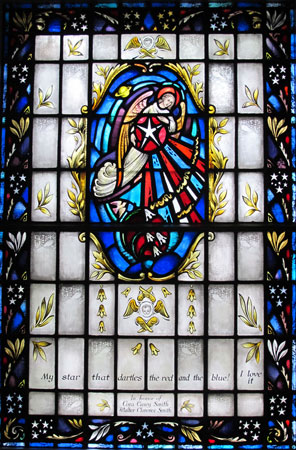
The angelic figure in the main image bears the star dartling its red and blue. There is the suggestion of "Saturn above it" along with a bird and the flower that "hangs furled." Note the stars that adorn the border.
The date of the poem's composition is unknown, but it probably belongs to Italy and Browning's married life. The tradition is that the poem was written to Elizabeth Barrett Browning. It was Browning's custom, when admirers asked for his autograph, to write out this poem.
Robert Browning's
"My Star"
All that I know
Of a certain star
Is, it can throw
(Like the angled spar)
Now a dart of red,
Now a dart of blue;
Till my friends have said
They would fain see, too,
My star that dartles the red and the blue!
Then it stops like a bird; like a flower, hangs furled:
They must solace themselves with the Saturn above it.
What matter to me if their star is a world?
Mine has opened its soul to me; therefore I love it.
My star that dartles the red and the blue!
In honor of Cora Casey Smith and Walter Clarence Smith
Gift of Mrs. Lois Smith Douglas Murray Strain
Belew Scholars' Room
Charles J. Connick Associates, Inc., Boston, Massachusetts
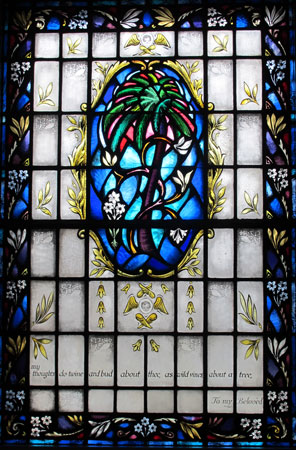
Elizabeth Barrett Browning's
Sonnets from the Portuguese, Sonnet 29
THINK of thee!--my thoughts do twine and bud
About thee, as wild vines--about a tree
Put out broad leaves, and soon there's nought to see
Except the straggling green which hides the wood.
Yet, O my palm-tree, be it understood
I will not have my thoughts instead of thee
Who art dearer, better! Rather instantly
Renew thy presence; as a strong tree should,
Rustle thy boughs and set thy trunk all bare.
And let these bands of greenery which insphere thee
Drop heavily down,--burst, shattered, every-where
Because, in this deep joy to see and hear thee
And breathe within thy shadow a new air,
I do not think of thee--I am too near thee.
My thoughts do twine and bud about thee,
as wild vines, about a tree.
To my beloved
Belew Scholars' Room
Charles J. Connick Associates, Boston, Massachusetts
Sordello, a narrative study in the psychology of genius and the development of a soul, is considered one of the most obscure of Browning's works and was a critical failure when published in 1840. It is a fictionalized account of the life of Sordello da Goito, a 13th-century troubadour-soldier. It is set in northern Italy as the country undergoes the struggle between the Guelphs (partisans of the Pope) and the Ghibellins (partisans of the Holy Roman Emperor). Sordello is a Ghibellin. The poem reveals the troubles that Sordello is experiencing as he is torn between the practical and the sublime, the demands of his poetic imagination, and his involvement in the power and glory of politics.
In this window, Sordello is represented at the moment in his life when he must accept all the joys of earth as the Emperor's Liegeman, or renounce them and follow the dictates of his heart as champion of the common people. Here, he has snatched the Emperor's badge from his neck and stamped it beneath his feet. Symbols of the Guelfs and the Ghibellins appear at the left and right, along with the mandolin (symbol of the troubadour). Copper beech and nightingales form the border, motifs that are also featured in the Memorabilia Window, also in the Belew Scholars' Room.
Lines from Sordello are emblazoned above the bronze entrance doors of the Armstrong Browning Library. They capture the essence of A. J. Armstrong's inspiration as he undertook the goal of building the largest Browning collection at Baylor University:
Would you have your songs endure?
Build on the human heart!
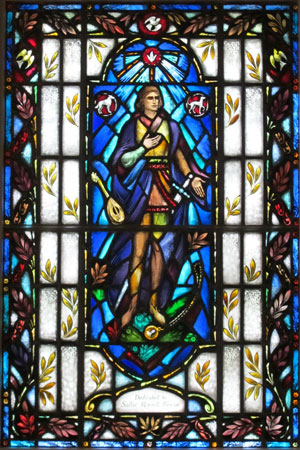
Excerpt from Robert Browning's Sordello
Here is the Crowd, whom I with freest heart
Offer to serve, contented for my part
To give life up in service,--only grant
That I do serve; if otherwise, why want
Aught further of me? If men cannot choose
But set aside life, why should I refuse
The gift? I take it--I, for one, engage
Never to falter through my pilgrimage--
Nor end it howling that the stock or stone
Were enviable, truly: I, for one,
Will praise the world, you style mere anteroom
To palace--be it so!
Dedicated to Sallie Rowell Foscue
Gift of Mrs. Ray Rowell, Sr.