

Elizabeth Barrett Browning Salon
Elizabeth Barrett Browning is possibly best known for her authorship of the forty-four Sonnets from the Portuguese. Five of the sonnets are represented in stained glass in the Austin Moore-Elizabeth Barrett Browning Salon on the third floor of the Library. Together the windows, created by Charles J. Connick Associates, Inc., Boston, Massachusetts, illustrate and convey the story of the courtship of Robert Browning and Elizabeth Barrett.
All of the windows, as well as the room itself, were given by Mr. & Mrs. Charles R. Moore in memory of their son, Austin (1907 - 1944), during a dedication ceremony held on 27 May 1951.
Please use the links below to view the windows in the Salon, learn about their significance to the courtship story, and enjoy the accompanying sonnets:
Sonnet 1, Window 1
Austin Moore - Elizabeth Barrett Browning Salon
Charles J. Connick Associates, Inc., Boston, Massachusetts
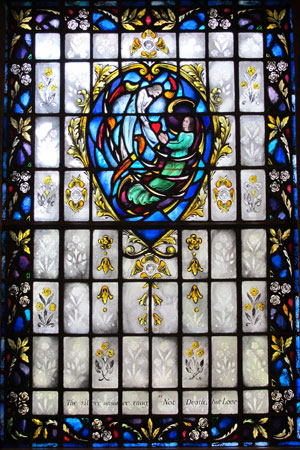
Elizabeth was thirty-eight years old when she wrote the first sonnet in her famous sonnet series, Sonnets from the Portuguese. She had been a semi-invalid for years and, in the sonnet, expresses a feeling that she is preparing for some great change in her life, assuming that the change will be death.
This first window symbolizes the Coming of Love. The Mystic Shape with the wings suggests the Seraphim of Love and surprises Elizabeth by dropping a red heart, symbolizing love, into her waiting hands.
Elizabeth Barrett Browning's
Sonnets from the Portuguese
Sonnet 1
I THOUGHT once how Theocritus had sung
Of the sweet years, the dear and wished-for years,
Who each one in a gracious hand appears
To bear a gift for mortals, old or young:
And, as I mused it in his antique tongue,
I saw, in gradual vision through my tears,
The sweet, sad years, the melancholy years,
Those of my own life, who by turns had flung
A Shadow across me. Straightway I was 'ware,
So weeping, how a mystic Shape did move
Behind me, and drew me backward by the hair,
And a voice said in mastery, while I strove,--
'Guess now who holds thee?'--'Death,' I said.
But, there,
The silver answer rang,--'Not Death, but Love.'
The silver answer rang, 'Not Death, but Love.'
In memory of Austin Moore
Gift of Mr. & Mrs. Charles R. Moore
Window 2, Sonnet 3
Austin Moore - Elizabeth Barrett Browning Salon
Charles J. Connick Associates, Inc., Boston, Massachusetts
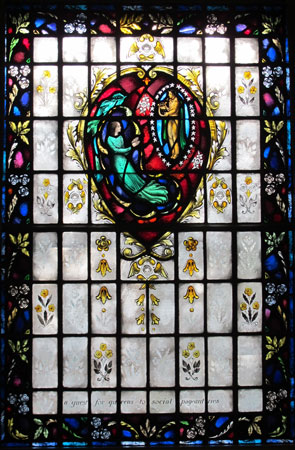
Robert, at the age of thirty-two, enters Elizabeth's life. In this second window of the series, Robert is dressed in gold, a color of warmth and friendship; and his cloak is green, symbolizing rebirth and healing. He carries a lyre, indicating that he is a poet. Elizabeth's hands are open to the acceptance of his friendship.
Elizabeth Barrett Browning's
Sonnets from the Portuguese
Sonnet 3
UNLIKE are we, unlike, O princely Heart!
Unlike our uses and our destinies.
Our ministering two angels look surprise
On one another, as they strike athwart
Their wings in passing. Thou, bethink thee, art
A guest for queens to social pageantries,
With gages from a hundred brighter eyes
Than tears even can make mine, to play thy part
Of chief musician. What hast thou to do
With looking from the lattice-lights at me,
A poor, tired, wandering singer, singing through
The dark, and leaning up a cypress tree?
The chrism is on thine head,--on mine, the dew,--
And Death must dig the level where these agree.
A guest for queens to social pageantries.
In memory of Austin Moore
Gift of Mr. & Mrs. Charles R. Moore
Window 3, Sonnet 8
Austin Moore - Elizabeth Barrett Browning Salon
Charles J. Connick Associates, Inc., Boston, Massachusetts
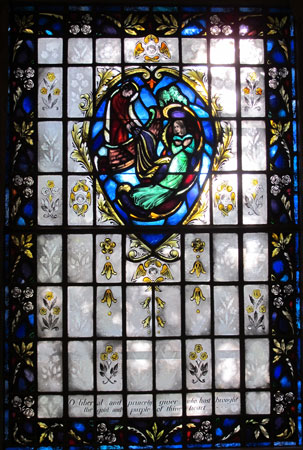
In the third window, Robert is dressed in red, the color of love. The purple and gold material of his flowing cape is a graphic representation of his marriage proposal, but Elizabeth's hands are crossed in a gesture of refusal. She is worried about the six-year age difference and does not want to burden Robert with an invalid wife. More troubling, her father had made it clear that he expected none of his eleven children to marry.
Elizabeth Barrett Browning's
Sonnets from the Portuguese
Sonnet 8
WHAT can I give thee back, O liberal
And princely giver, who hast brought the gold
And purple of thine heart, unstained, untold,
And laid then, on the outside of the wall
For such as I to take or leave withal,
In unexpected largesse? am I cold,
Ungrateful, that for these most manifold
High gifts, I render nothing back at all?
Not so; not cold,--but very poor instead.
Ask God who knows. For frequent tears have run
The colors from my life, and left so dead
And pale a stuff, it were not fitly done
To give the same as pillow to thy head.
Go farther! let it serve to trample on. <
O liberal and princely giver who hast brought
the gold and purple of thine heart.;
In memory of Austin Moore
Gift of Mr. & Mrs. Charles R. Moore
Window 4, Sonnet 11
Austin Moore - Elizabeth Barrett Browning Salon
Charles J. Connick Associates, Inc., Boston, Massachusetts
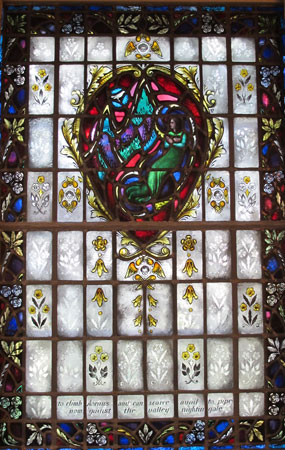
The dove inside a circle of blue on this fourth window symbolizes the contemplative nature of the eleventh sonnet. Elizabeth is rethinking her decision not to marry Robert. However, her hands are still crossed as she continues to reject him.
Elizabeth Barrett Browning's
Sonnets from the Portuguese
Sonnet 11
AND there if to love can be desert,
I am not all unworthy. Cheeks as pale
As these you see, and trembling knees that fail
To bear the burden of a heavy heart,--
This weary minstrel-life that once was girt
To climb Aornus, and can scarce avail
To pipe now 'gainst the valley nightingale
A melancholy music,--why advert
To these things? O Beloved, it is plain
I am not of thy worth nor for thy place!
And yet, because I love thee, I obtain
From that same love this vindicating grace
To live on still in love, and yet in vain,--
To bless thee, yet renounce thee to thy face.
To climb Aornus and can scarce avail to pipe
now 'gainst the valley nightingale.
In memory of Austin Moore
Gift of Mr. & Mrs. Charles R. Moore
Window 5, Sonnet 43
Austin Moore - Elizabeth Barrett Browning Salon
Charles J. Connick Associates, Inc., Boston, Massachusetts
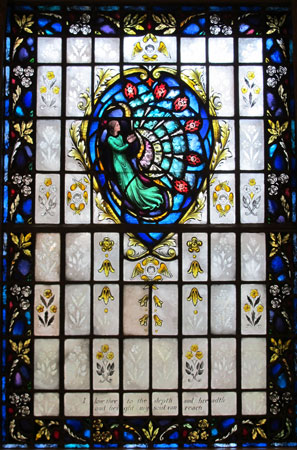
Elizabeth accepts Robert's proposal, and this fifth and final window seems to proclaim joy and ever-lasting love. The spreading bands of color radiating from Elizabeth's open hands are red-winged Seraphim, the traditional symbols of love, and represent Elizabeth's prayers for Robert and her upcoming marriage. The two were secretly married at St. Marylebone Parish Church in London on Saturday, 12 September 1846.
Elizabeth Barrett Browning's
Sonnets from the Portuguese
Sonnet 43
HOW do I love thee? Let me count the ways.
I love thee to the depth and breadth and height
My soul can reach, when feeling out of sight
For the ends of Being and ideal Grace.
I love thee to the level of everyday's
Most quiet need, by sun and candle-light.
I love thee purely, as they turn from Praise.
I love thee with the passion put to use
In my old griefs, and with my childhood's faith.
I love thee with a love I seemed to lose
With my lost saints,--I love thee with the breath,
Smiles, tears of all my life!--and, if God choose,
I shall but love thee better after death.
I love thee to the depth and breadth
and height my soul can reach.
In memory of Austin Moore
Gift of Mr. & Mrs. Charles R. Moore